Key Takeaways
- Cyber risks are increasing in frequency and sophistication, outpacing traditional assessment models that rely on manual reviews and static controls.
- Outsourcing cyber risk assessment to AI-powered digital FTEs delivers real-time threat intelligence, consistent evaluation quality, and scalable expertise.
- AI-FTEs enhance underwriting, compliance, and enterprise cyber governance through predictive scoring, automated vulnerability analysis, and global threat monitoring.
- Modern cyber risk assessment now demands continuous intelligence—not periodic checklists—and AI-driven digital FTEs fill this gap efficiently and affordably.
A New Reality: Cyber Risk Isn’t a Periodic Task Anymore
Cyber insurance is evolving faster than most underwriting teams can keep up with. Threat surfaces are expanding, attack patterns are shifting weekly, and traditional risk evaluation methods—questionnaires, static frameworks, and manual document reviews—simply can’t capture the dynamic nature of cyber exposure.
According to a study, a 30% YoY increase in global cyberattacks was observed in 2024, reaching 1,636 attacks per organization per week. Hence, insurers need both speed and depth, and achieving that internally is becoming a mounting challenge.
Outsourcing cyber risk assessment has emerged as one of the most effective ways for insurers to scale capability, reduce operational burden, and gain access to specialized digital expertise—without the heavy investment required to build and retain in-house cyber talent. When these outsourced teams are augmented with AI-driven risk intelligence tools and agents, the result is an assessment engine that is faster, more precise, and fundamentally more adaptive to today’s cyber threat environment.
This blog explores how outsourced digital FTEs, powered by AI, are reshaping the cyber risk lifecycle and delivering underwriting outcomes that were previously difficult to achieve at scale.
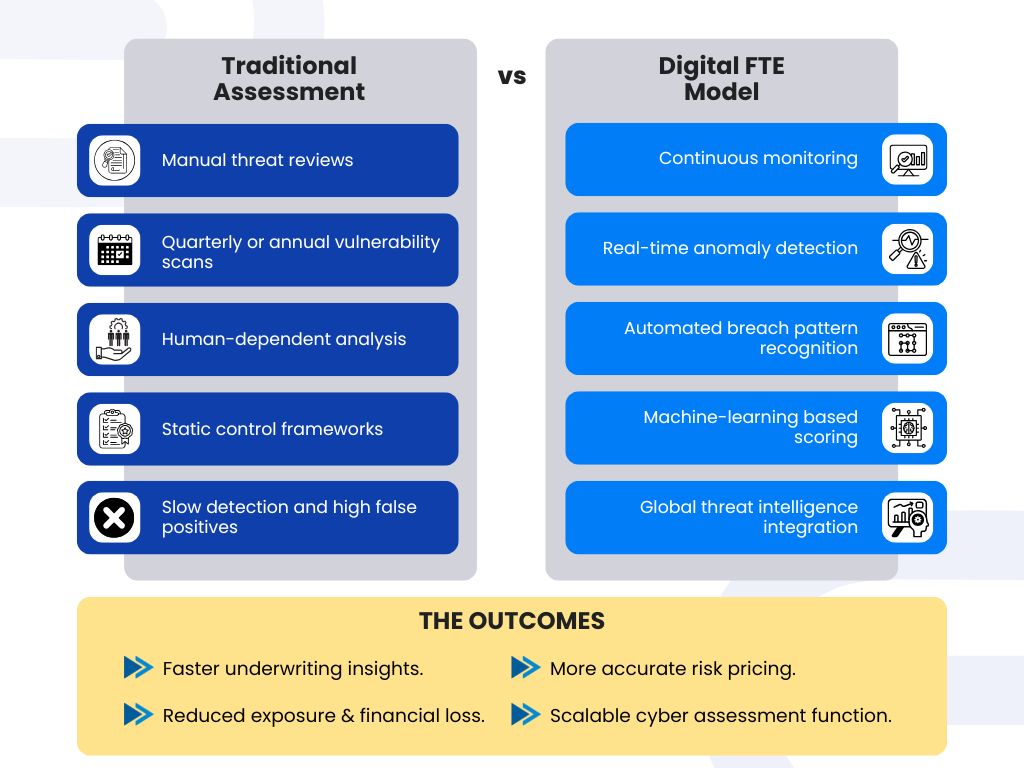
Cyber Risk Assessment: Traditional vs AI-Driven Digital FTEs
Here’s a quick snapshot of how traditional cyber assessments compare to an AI-driven digital FTE model—and why the shift is transforming underwriting.
Why Outsourcing Cyber Risk Assessment Makes Sense Today
Cyber underwriting is one of the most talent-intensive lines of business. It requires constant threat intelligence monitoring, deep technical understanding of network vulnerabilities, and an ability to evaluate non-standardized cybersecurity practices across diverse industries. Most carriers simply don’t have the capacity to build this internally at the pace the market demands.
Outsourcing solves this capability gap in three ways:
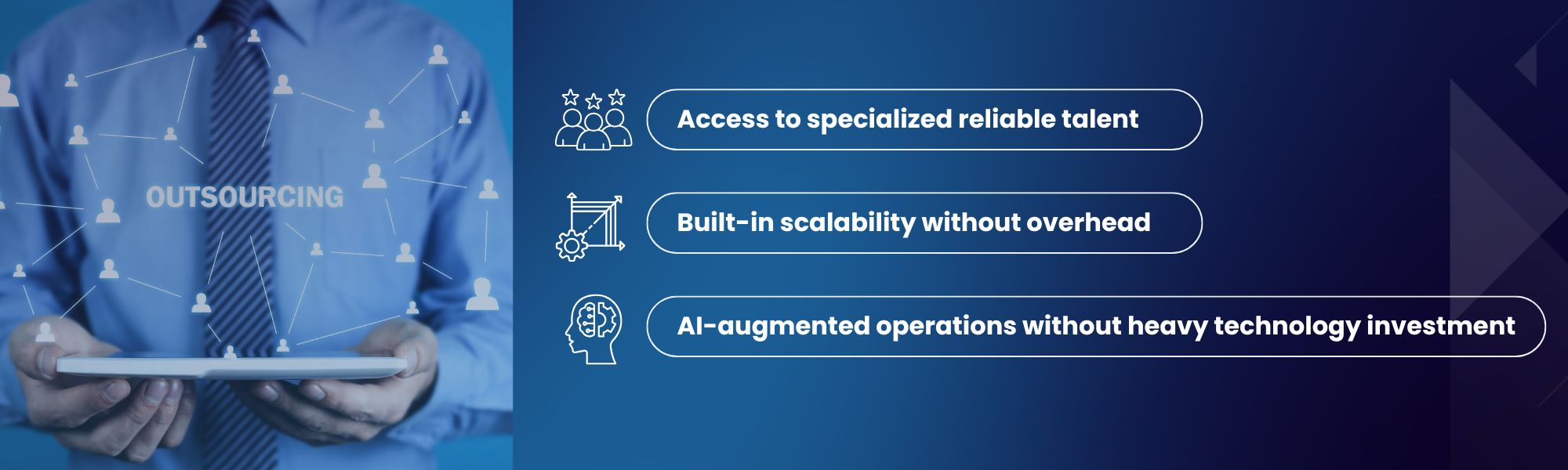
This combination—reliable human expertise, operational flexibility, and AI-enabled intelligence—is exactly what modern cyber underwriting needs. And it’s why insurers are increasingly leaning toward outsourcing as their primary operating model for cyber risk assessment.
How AI-Augmented Digital FTEs Transform the Cyber Risk Assessment Lifecycle
Outsourced digital FTEs bring structure, consistency, and speed to cyber risk assessment—helping insurers process submissions faster and with deeper intelligence. At the center of this model is the Cyber Risk Assessment Agent, an AI-powered capability embedded into the outsourced team. It strengthens underwriting decisions by delivering three core functions:
- Evaluates cybersecurity vulnerabilities and threat exposure
Scans the organization’s security posture—technology stack, configurations, and external exposure indicators—so potential weaknesses are surfaced early in the assessment.
- Assesses historical breach and phishing risks
Compiles and analyzes available breach histories, phishing indicators, and prior incident patterns, providing underwriters with a clearer view of behavioral and systemic risk.
- Generates cyber risk scoring for precise policy pricing
Produces dynamic scoring that reflects likelihood, severity, and overall security maturity, enabling more accurate pricing, terms, and coverage recommendations.
Supported by outsourced digital FTEs who validate findings and add context, insurers receive underwriting-ready intelligence—without needing to build these capabilities internally.
The Future of Cyber Underwriting Is Outsourced + AI- Augmented
As cyber threats escalate in complexity and frequency, organizations need assessment models that move at the same pace. Outsourcing cyber risk assessment to AI-driven digital FTEs delivers the speed, accuracy, and intelligence required to stay ahead of modern attacks. The shift isn’t about replacing human expertise—it’s about augmenting it with scalable, data-driven automation.
If your underwriting team is ready to modernize its cyber assessment workflow, partnering with AI-augmented digital FTEs is the fastest path to measurable impact. Connect with Primis, and we’ll guide the rest!
Recent Blogs
Elevating Cyber Risk Assessment
The AI FTE Approach to Property Risk Assessment
Optimizing Auto Insurance Underwriting Through Outsourced AI-Driven Risk Intelligence
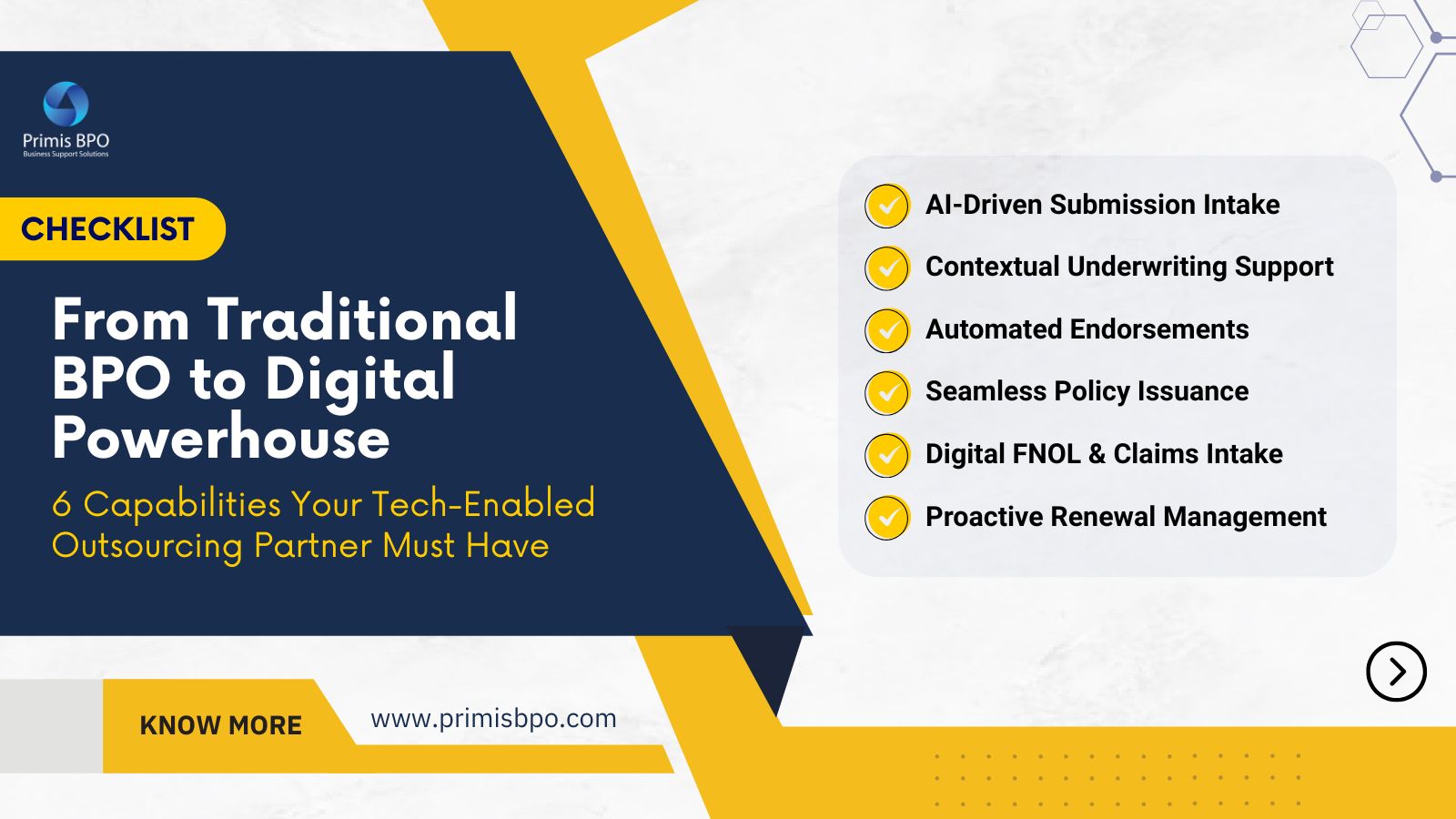
[Checklist] From Traditional BPO to Digital Powerhouse: 6 Capabilities Your Tech-Enabled Outsourcing Partner Must Have
Outsourcing AI-Enabled Property Risk Analysis


